Top Ethical Hacking Trends to Watch in 2026
Written by Emily Hilton
With the constant shift of workloads to cloud platforms, the expansion of hybrid and multi-cloud environments, and the acceptance of remote and hybrid work as the standard, the year 2026 sees a larger and more complicated attack surface than ever before. Adding to the rapid adoption of artificial intelligence (AI) across the board for both legitimate business use and by malevolent actors, the cybersecurity landscape is changing very fast.
2026 will mark a turning point where traditional security paradigms will be tested and where ethical hacking, continuous vulnerability assessment, and proactive defence strategies will become indispensable.
In such a scenario, ethical hackers equipped with the proper skills, tools, and attitude will be very important in the future for the protection of digital infrastructure, prevention of breaches, and assisting companies in staying ahead of the competition. This post is going to talk about the main trends that ethical hackers and security teams will have to watch in 2026.
The Growing Role of AI: From Defence to Attack
One of the defining cybersecurity trends in 2026 will center around AI. On the defensive side, AI in cybersecurity is becoming mainstream: machine-learning-based intrusion detection and real-time threat detection systems are helping security teams process enormous volumes of data, detect anomalies, and automate responses faster than ever.
The global cybersecurity market size was estimated at USD 245.6 billion in 2024, and it's projected to expand to USD 500.7 billion by 2030, growing at a CAGR of ~12.9% between 2025 and 2030. Simultaneously, attackers are getting smarter. The rise of “agentic AI,” autonomous AI agents capable of scanning networks, adapting phishing campaigns, and launching attacks with minimal human input, is one of the biggest shifts toward AI-powered cyberattacks.
For ethical hackers, this means familiar attack vectors are evolving. Traditional techniques may no longer suffice; understanding AI-generated threats, adversarial AI, or AI‑augmented exploitation will become essential. Ethical hacker responsibilities will expand into challenging new domains where AI and cybersecurity intersect.
Top Ethical Hacking Trends in 2026
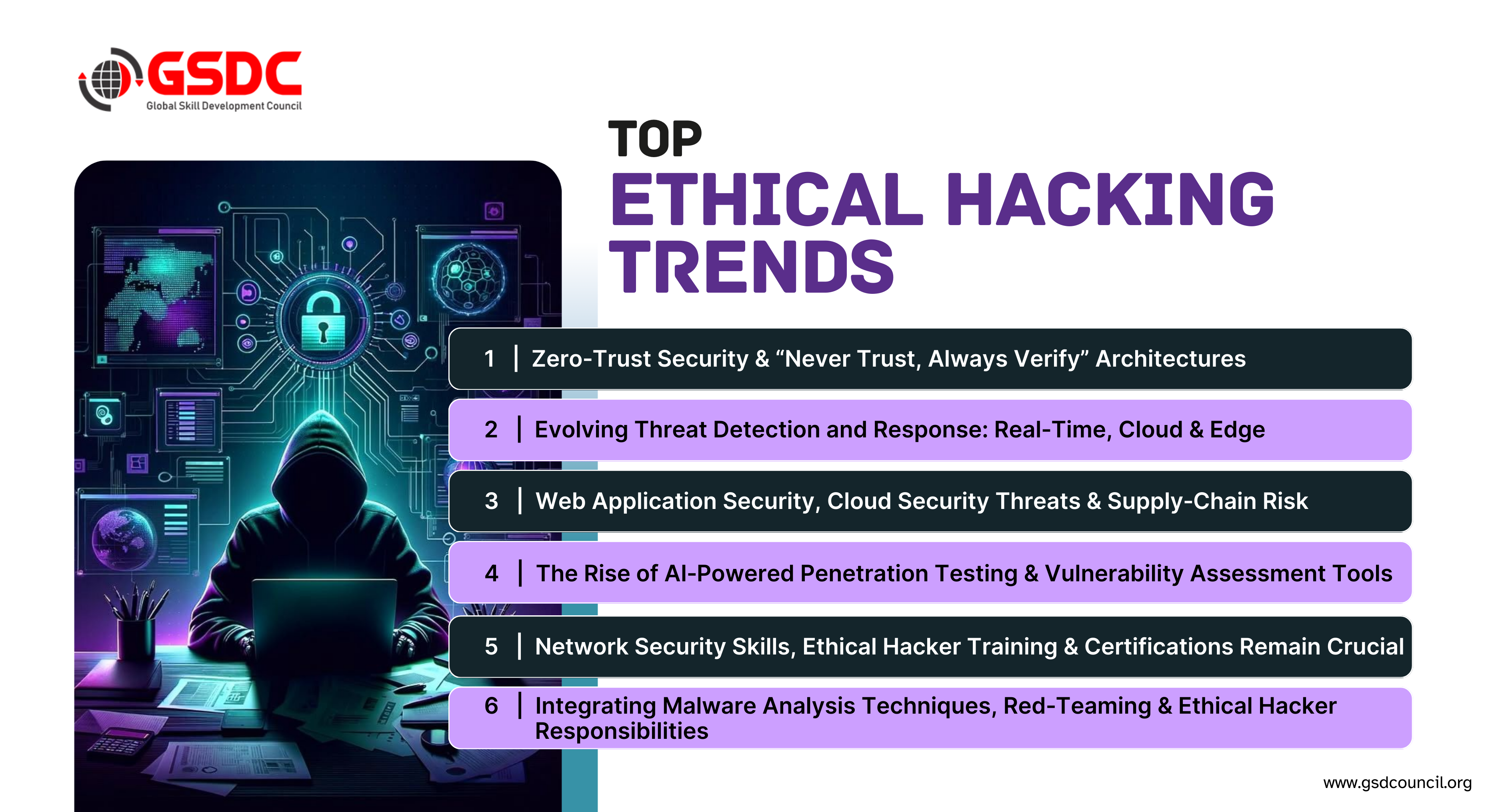
1. Zero‑Trust Security & “Never Trust, Always Verify” Architectures
Another hallmark of cybersecurity trends 2026 is the widespread adoption of dynamic, AI‑driven versions of zero trust security (Zero‑Trust Architecture or ZTA 2.0). The traditional perimeter-based defence is increasingly obsolete in a world of cloud services, mobile workforces, and remote access.
In ZTA 2.0, every access request, whether coming from inside or outside the network, is verified in real time based on contextual and behavioral intelligence. For example, a login from an unusual location or time may trigger adaptive multi-factor authentication (MFA), biometric verification, or access denial.
For ethical hacking and security audits, this means penetration testing must evaluate not only traditional vulnerabilities, but also identity‑based weaknesses, mis‑implemented authentication/authorization flows, privilege escalations, and compliance with micro‑segmentation policies. Ethical hackers will need to test ZTA implementations, identity and access management (IAM) systems, device posture checks, and think beyond the perimeter.
2. Evolving Threat Detection and Response: Real‑Time, Cloud & Edge
By 2026, threat detection platforms will evolve significantly from simple alerting engines to full-blown investigation and response ecosystems. The best systems will correlate signals across endpoints, network, identity, cloud workloads, edge devices, and SaaS applications to detect lateral movement or identity misuse across hybrid environments.
The days of periodic scanning are giving way to continuous exposure management and real‑time threat detection and response. Instead of waiting for the next quarterly or monthly scan, organizations will adopt tools that continuously monitor for misconfigurations, privilege drift, identity anomalies, and unusual behavior, enabling faster containment and remediation.
Furthermore, with cloud workloads, IoT/edge adoption, and hybrid work environments, network boundaries are dissolving, making legacy, perimeter‑centric detection obsolete. To stay ahead, organizations need unified visibility across cloud, SaaS, edge devices, and on-prem systems. For ethical hackers, this means testing must cover these hybrid environments, cloud misconfigurations, identity misuse, and lateral movement detection/resilience.
3. Web Application Security, Cloud Security Threats & Supply‑Chain Risk
The importance of web and cloud security threats is rising rapidly as organizations increasingly rely on web applications, SaaS platforms, and cloud-native services. Today, hackers take advantage of web application weaknesses, insecure APIs, misconfigured cloud services, and the use of compromised third-party components to gain unauthorized access to networks.
The role of ethical hackers will also evolve as they must expand beyond traditional Application Security Testing (AST) offensive activities and develop skills in cloud security posture management, container security, API testing, and supply-chain security audits.
Modern web application assessments will have to encompass containerized microservices, cloud-native deployments, identity flows, API endpoints, and embedded third-party integrations in order to protect the digital ecosystems of the future.
Key Highlights
- Increasing risks against APIs, web application flaws, misconfigured cloud platforms, and third-party dependencies.
- Supply-chain attacks taking place require full lifecycle security and constant monitoring.
- Possibility of end-to-end visibility and stringent evaluation of external components.
- Ethical hackers need to be well-versed in container security, API testing, and cloud posture assessments.
- Nowadays, testing goes beyond cloud-native architectures, microservices, identity flows, and supply-chain reviews.
4. The Rise of AI‑Powered Penetration Testing & Vulnerability Assessment Tools
Thanks to advances in generative AI, automation, and machine learning, the tools for ethical hacking and vulnerability assessment are themselves evolving rapidly. Researchers recently proposed systems like PenTest++, which integrate AI to automate major parts of the penetration testing workflow, reconnaissance, scanning, enumeration, exploitation, and reporting, while still allowing human oversight where needed.
Similarly, adaptive cybersecurity frameworks that combine AI with traditional network security systems are being developed to offer real-time network protection that integrates with zero‑trust models and cloud‑native architectures.
5. Network Security Skills, Ethical Hacker Training & Certifications Remain Crucial
Despite the quick rise of automation and AI-empowered security tools, human skill in ethical hacking is still very much needed. Cyberattacks are getting more sophisticated, mixing up the old weakness with AI-driven penetration, identity theft, supply chain hacking, and fake video manipulation.
This creates a need for ethical hackers who possess very good basic and practical skills. The need for ethical hacking certifications and licensure programs will not only be steady but also will probably be overwhelming, leading the techs to keep updating their skills forever.
Current ethical hacking education should now also include AI-enabled threat detection, automated scanning, container security, and practical incident response, apart from just web, cloud, and network security.
Key Highlights
- Cyber threats now overlap the classical flaws with AI-based, identity-based, supply-chain, and deepfake attacks.
- Increasing demand for ethical hacking certifications and structured training programs.
- Professionals must master web, cloud, network security, malware analysis, and vulnerability assessment tools.
- The training now covers container security, hybrid cloud hygiene, microservice testing, automated scanning, and AI-driven detection.
- Certifications are geared towards hands-on cloud-native penetration testing, automation, and real-world incident response scenarios.
6. Integrating Malware Analysis Techniques, Red‑Teaming & Ethical Hacker Responsibilities
With the use of advanced attacker techniques such as AI-generated malware, deepfakes for social engineering, attacking via the supply chain, and multi-vector exploits, ethical hackers need to broaden their horizons, targeting malware analysis, threat hunting, and red teaming as their new exterior areas of battle.
To achieve this goal, the use of malware analysis consisting of reverse-engineering; behavioral analysis, memory forensics, and sandboxing will increase along with the need for understanding and defending against novel threats. The times when an attacker relied on AI-generated malware or polymorphic code to camouflage their traces are gone. Human analysts driven by deep understanding and context will now be the ones to detect, dissect, and mitigate these threats.
Thus, the job of the ethical hacker is not only limited to the detection of security vulnerabilities but also involves impersonating realistic enemies, testing AI protections, ensuring supply chain security, constantly evaluating risk exposure, and contributing to a company’s cyber resilience posture as a whole.
📥 Download Your Free Guide Now!
🚀 Boost Your L&D Career with Proven Strategies
✅ Start Your Journey to Becoming a Certified Trainer Today
How Ethical Hacking Foundation Certification Will Help You in 2026?
GSDC’s Ethical Hacking Foundation Certification provides practical skills to professionals who use it to discover the shortcomings in the systems, to make those systems secure, and also to protect the organizations from continuous cyber attacks.
Obviously, cybercrime will be rampant in 2026 , and thus, companies will seek to hire the best and most skilled ethical hackers who will protect their digital assets and also help them become more responsive to incidents.
The security assessment, penetration testing, and ethical hacking frameworks that this certification provides will make you a great addition to the cybersecurity team and will also give you a chance to pursue attractive security career paths.
Key Benefits
- Improvements in cybersecurity skills with the help of real-world ethical hacking methods and security testing basics.
- Career opportunities in positions like Security Analyst, Pen Tester, and Vulnerability Assessor are going to increase.
- The person will be recognized more by the firm that he works for because of the international certification that proves his practical competence.
- Security standards compliance, as well as the application of threat-prevention strategies, will be possible for the organization.
What This Means for Professionals: Skills, Mindset & Continuous Learning
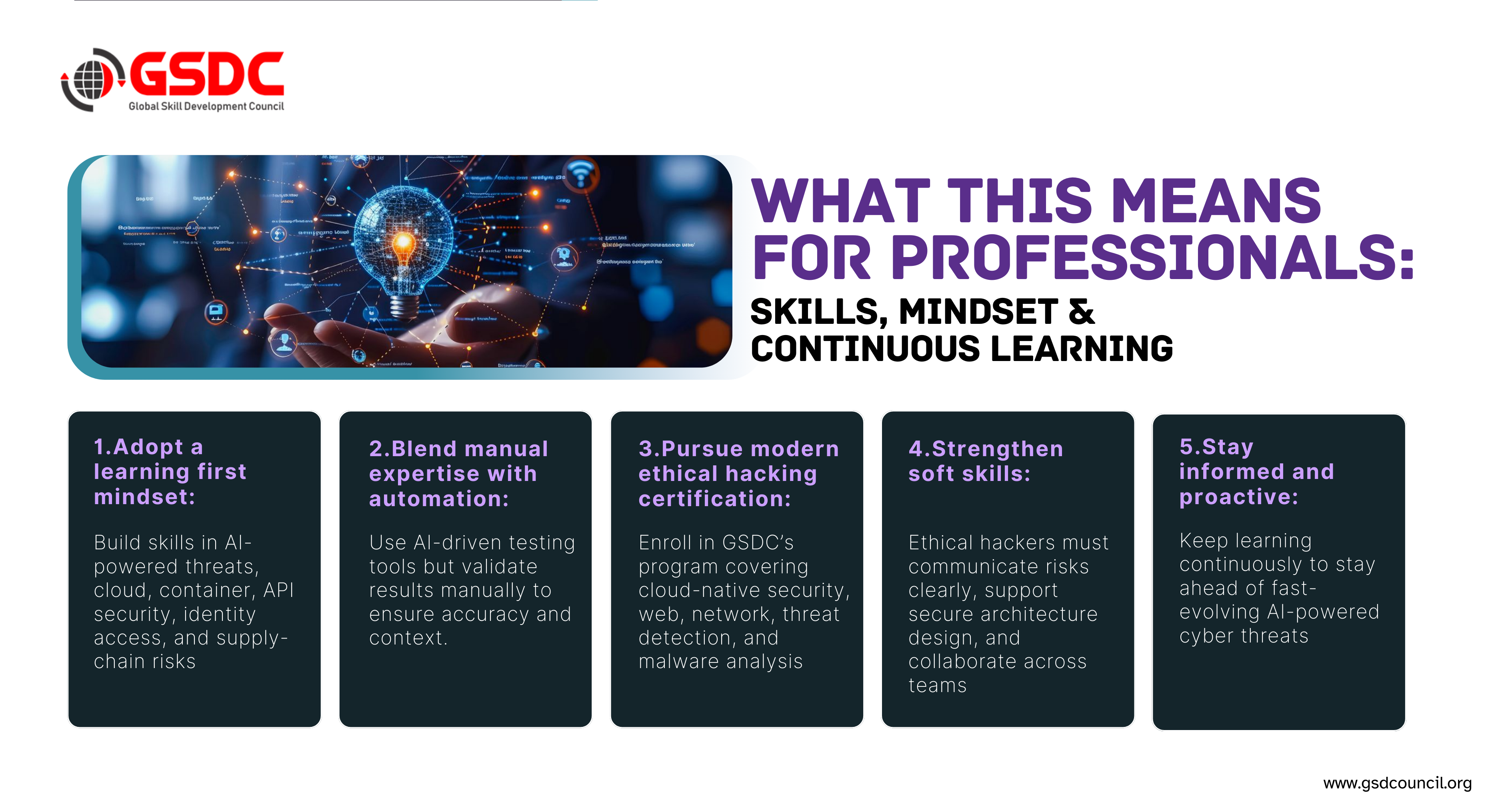
Given these evolving cybersecurity trends in 2026, ethical hackers and security professionals must adapt proactively. Here are some recommendations:
- Adopt a learning‑first mindset: Invest time in understanding AI‑powered threats, cloud security, container & API security, identity‑based access control, and supply‑chain risk.
- Blend manual expertise with automation: Use AI‑powered vulnerability assessment tools and penetration testing frameworks, but always validate results manually, interpret context, and mitigate false positives/negatives.
- Pursue modern ethical hacking certification: Enroll in GSDC’s Ethical Hacking Foundation Certification program that covers cloud-native architectures, web application security, network security, cloud security threats, threat detection & response, and malware analysis.
- The soft skills of the hacker: The duties of an ethical hacker now encompass not only technical testing but also, among other things, reporting risks, assisting in the creation of secure architectures, and working with teams from different departments.
- Keeping oneself informed and being proactive: The rapid change of the landscape, particularly due to AI-fueled attacks, will necessitate continuous learning, periodic training, and being ahead of the very threat landscapes.

Conclusion: Preparing for a Dynamic, AI‑Infused Cybersecurity Future
The year 2026 is going to be quite a year in the growth of cybersecurity, a year characterized by the convergence of AI with ordinary security, the cloud-native expansion, hybrid environments, identity-first architectures, and upgradeable threat landscapes. Ethical hacking will not be a niche practice anymore, but rather a critical element of an organization’s future of AI in cybersecurity.
As cybersecurity trends 2026 reshape how we think about risk, defense, and offense, ethical hacker training, vulnerability assessment tools, web application security, cloud security, network security skills, malware analysis techniques, and threat detection and response will all be front and center.
For professionals, staying relevant will require agility, continuous learning, and readiness to confront the new challenges of an AI‑powered cyber landscape. Ethical Hacking Foundation Certification and real-world hands‑on experience will remain vital, but so will adaptability, strategic thinking, and a broad understanding of modern infrastructures.

Related Certifications
Stay up-to-date with the latest news, trends, and resources in GSDC
If you like this read then make sure to check out our previous blogs: Cracking Onboarding Challenges: Fresher Success Unveiled
Not sure which certification to pursue? Our advisors will help you decide!