Certified Full Stack Data Scientist
The Certified Full Stack Data Scientist program is globally designed to enhance data science expertise, advanced analytics capabilities, and end-to-end data solution development across modern enterprises.
Learn directly from global data science practitioners, analytics experts, and industry leaders who are shaping the future of data-driven innovation and intelligent decision-making.
What Sets Our Program Apart?
- Globally Recognized Certification with Self-Paced Learning
- E-Learning Library Access, Ebook
- LinkedIn Enhancer & Professional Resume Builder
- Capstone Projects
- Generative AI Interview Practice Platform
100% Money Back Guarantee on One-Click









Objectives Of Full Stack Data Science
- Apply Python, SQL, and big data technologies effectively
- Master statistics, mathematics, and hypothesis-driven analysis
- Build, train, and optimize machine learning models
- Apply deep learning techniques for vision and NLP
- Design scalable pipelines and ensure data governance
- Deploy, monitor, and retrain models with MLOps practices
- Learn from case studies and real-world industry scenarios
- Use expert-crafted templates for faster project implementation
Benefits Of Full Stack Data Science
- Bridge business needs with data-driven solutions
- Master Python, SQL, and modern data workflows
- Apply advanced statistics for real-world decision-making
- Build scalable ETL pipelines and manage big data
- Design accurate ML models with practical applications
- Gain expertise in deep learning and NLP use cases
- Deploy and monitor models with MLOps best practices
- Showcase end-to-end ownership of the data lifecycle
- Leverage industry case studies and expert-built templates
- Strengthen career prospects across AI and analytics roles
Exam Syllabus of Full Stack Data Scientist Certification
1 Business Acumen & Product Management+
•Business Analysis & Stakeholder Management
•Requirement Elicitation & Documentation
•Project Methodologies (Agile, Scrum, Kanban)
•Problem Framing & Solution Scoping
•Communication & Presentation Skills
•Value Proposition & Business Impact
•Risk Management & Prioritization
2 Python Programming for Data Science+
•Core Python Fundamentals (Data Types, Control Flow)
•Object-Oriented Programming (OOP)
•Data Manipulation with Pandas & NumPy
•Data Visualization with Matplotlib & Seaborn
•Error Handling & Debugging
•Working with APIs & Web Scraping
•Code Versioning with Git & GitHub
3 Statistics and Mathematics for Data Science+
•Probability Theory & Distributions
•Descriptive & Inferential Statistics
•Hypothesis Testing & A/B Testing
•Linear Algebra for Machine Learning
•Calculus Fundamentals for Optimization
•Dimensionality Reduction (PCA, t-SNE)
•Statistical Modeling & Regression Analysis
4 Data Engineering and SQL+
•Database Fundamentals (Relational vs. NoSQL)
•Advanced SQL Queries & Window Functions
•Data Warehousing Concepts
•Building ETL/ELT Pipelines
•Data Governance & Quality
•Big Data Ecosystem (Hadoop, Spark)
•Cloud Data Services (e.g., AWS S3, Google BigQuery)
5 Machine Learning Fundamentals+
•Supervised Learning (Regression & Classification)
•Unsupervised Learning (Clustering & Association)
•Model Evaluation Metrics (Accuracy, Precision, Recall)
•Cross-Validation & Hyperparameter Tuning
•Bias-Variance Tradeoff
•Feature Selection & Engineering
•Ensemble Methods (Random Forest, Gradient Boosting)
6 Deep Learning & Advanced AI+
•Introduction to Neural Networks & Perceptrons
•Activation Functions & Backpropagation
•Convolutional Neural Networks (CNNs) for Computer Vision
•Recurrent Neural Networks (RNNs) for Sequential Data
•Natural Language Processing (NLP)
•Transfer Learning
•Deep Learning Frameworks (TensorFlow, PyTorch)
7 MLOps & Deployment+
•DevOps Principles for ML
•Containerization with Docker
•Orchestration with Kubernetes
•CI/CD Pipelines for ML Models
•Model Serving & API Development
•Monitoring & Logging
•Model Retraining & Versioning
How to Earn Full Stack Data Scientist Certification
1 Steps to Become a GSDC Certified Full Stack Data Scientist+
•Complete all learning materials provided in the course.
•Finish case study assignment on key Full Stack Data Scientist concepts.
•Submit your completed assignment for review and approval.
•Pass the final MCQ exam to earn your certification.
Learn from Experts
Learn from experienced practitioners and industry leaders who bring real-world expertise and practical insights to the program.

Antonio Grasso
INTEL CORPORATION , SIEMENS AG
INTEL SOFTWARE INNOVATOR, SIEMENS AG INFLUENCER

Shameer Thaha
ACCUBITS (MENA)
CEO

Harinder Seera
OZPERF
CTO, PERFORMANCE TEST CONSULTANT, SPEAKER
Enrollment Options
Single Access
Gain full access to our complete resource library and earn a globally recognized certification.
1 Certificate Programs
For Teams
Enable teams with GSDC certification pathways and customized learning journeys aligned with business priorities.

7 Day Money-Back Guarantee

Target Audience For Data Scientist Certification
Pre-Requisites For Data Scientist Certification
Prior knowledge of programming, statistics, or data-related concepts is recommended, but not mandatory, to pursue this certification.
Exam Details Of Data Science Certificate
Exam Questions
40
Exam Format
Multiple choice
Language
English
Passing Score
65%
Duration
90 min
Open Book
No
Certification Validity
5 Years
Complimentary Retake
Yes
Sample Certification
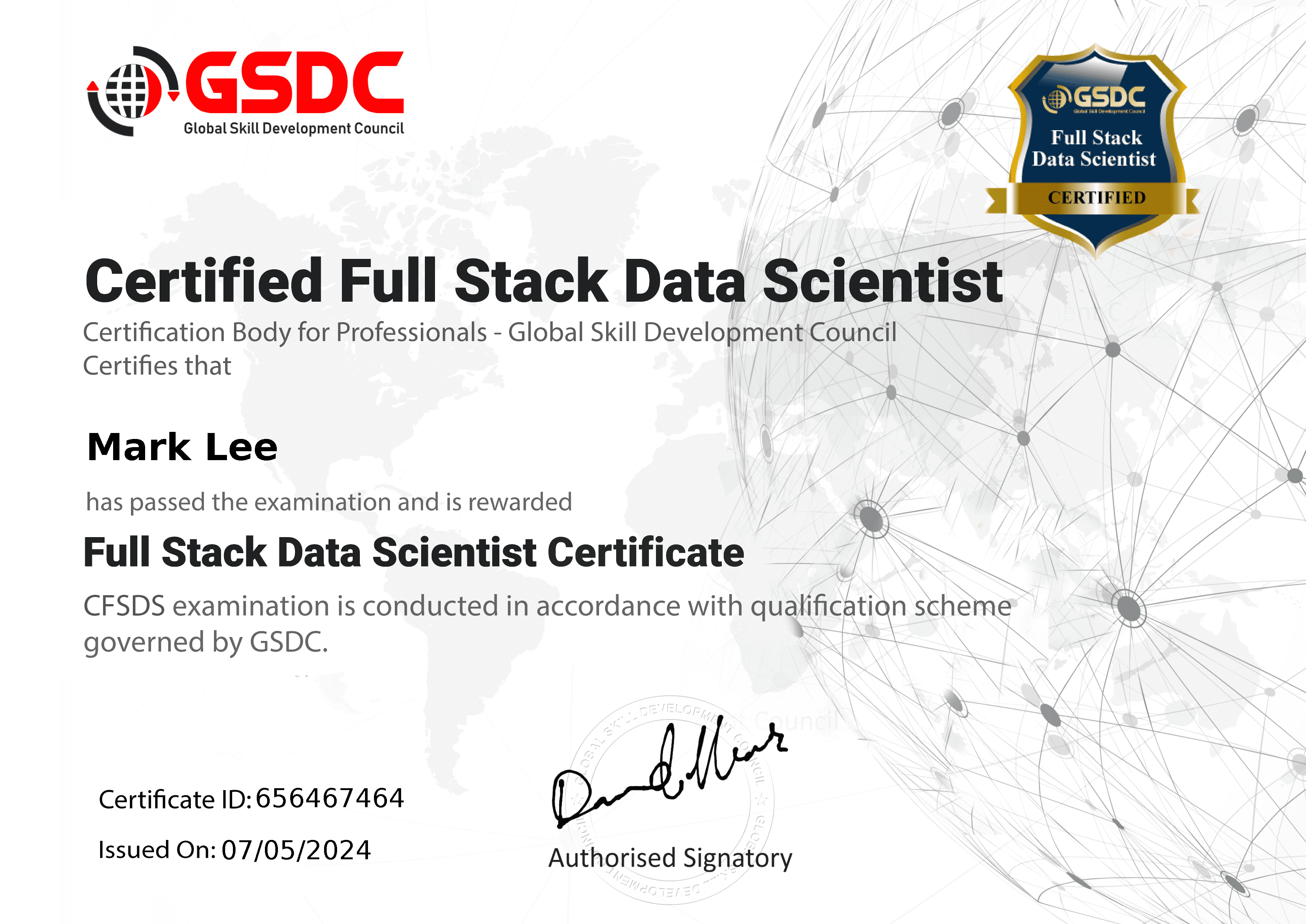
About Data Scientist Certification
The GSDC Certified Full-Stack Data Scientist (CFDS) credential validates end-to-end expertise in every part of the data science lifecycle, business problem framing, data engineering, advanced analytics, machine learning, deep learning, and model deployment.
The credential is globally recognized and designed for professionals who want to demonstrate not only technical skills but also business aptitude and product-oriented thinking. The CFDS provides an individual with knowledge of Python programming, statistics, machine learning, big data, and MLOps so that he or she can implement scalable solutions that have real-world impact.
A professional Certified Full-Stack Data Scientist is recognized as an all-rounder, proficient with the entire pipeline: from business needs into requirements, bugs into working validated models, and from production to maintenance. The certification focuses on applications, case studies, and industry-ready implementations, making it quite useful in analytics, AI, and digital transformation.